Table Of Content
We need to check for invalid symbols as before, so we have the code determine if romanSymbols contains a specific key and if not, throw the exception. Run the test cases again, and we see the green bar for all cases. An issue to avoid here is the null pointer exception rising from a line of code such as roman.equals("I"). To fix it, simply invert the equality to "I".equals(roman). By implementing the convertRomanToArabicNumber method to throw IllegalArgumentException, we are sure that we have reached the red state. TDD is key to developing and maintaining such steps until we cover all the cases of the problem at hand.
Digital Experience Testing
We offer education in human-centered design, including an undergraduate Design Minor and the Design Graduate Specialization). In this way, TDD purism belongs to the world of dynamic typing; being a TDDpurist in Rust is a mistake, but being a type-driven designer in Ruby is also amistake. Neither of these techniques are wrong, but they are different. However, as good as automatic test design can be, it is not appropriate for all circumstances. If the complexity becomes too high, then human test design must come into play as it is far more flexible and it can concentrate on generating higher level test suites. In software engineering, test design is the activity of deriving and specifying test cases from test conditions to test software.
Navigating the ethical waters of Agile coaching with Alex Sloley
Ask two developers what they believe an integration test is. As Fowler writes, there are two completely different notions of what this means, and we still haven't converged on a standard. TDD has its roots in Agile methodology and eXtreme Programming (XP). While TDD brings many benefits, it may not suit all projects. Project managers must access the context and apply it accordingly. Developers who dislike TDD may think of the practice as a constricting activity, but proponents of TDD actually feel the opposite — they find the practice quite freeing.
NewSchool of Architecture & Design
Tests used in TDD can often be derived from ATDD tests, since the code units implement some portion of a requirement. Test Driven Development (TDD) is software development approach in which test cases are developed to specify and validate what the code will do. In simple terms, test cases for each functionality are created and tested first and if the test fails then the new code is written in order to pass the test and making code simple and bug-free.
Write the simplest code to make the test pass
Both Acceptance TDD and Developer TDD aims to specify detailed and executable requirements for the solution on a just-in-time (JIT) basis. JIT involves considering only the requirements necessary for the system, resulting in increased efficiency. When we follow the three rules of TDD, all our code will be testable. Understanding the three rules of TDD is fundamental to writing clean, stable, and consistent code. Following best practices to get the most out of Test-driven Development is important.
You can easily allocate TDD activities into Agile sprints. Once you fail your test, you have reached the Red stage of the Red - Green - Refactor cycle. After making changes to class PassValidator () if we run the test then the output will be PASSED as shown below. Here in this Test Driven Development example, we will define a class password.
Step 10
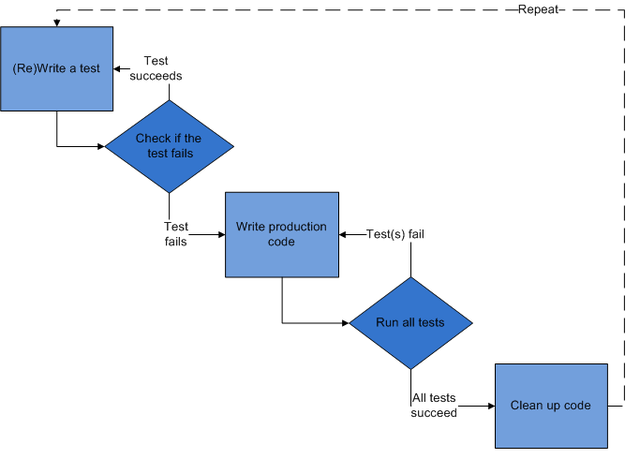
It is an iterative approach combining programming, unit test creation, and refactoring. Test-Driven Development starts with designing and developing tests for every small functionality of an application. TDD framework instructs developers to write new code only if an automated test has failed. TDD is a design process that helps to achieve cleaner code with high coding standards. It does not actively modify the code to see if it works.

Agile Conferences
You will apply many of the technologies and concepts you've learned in the course and will create a microservice for a product catalog backend to an eCommerce application. The UI of the eCommerce application will be used by administrators to maintain the product catalog. In the first part of this project, you will use good Test Driven Development practices to create a REST API that allows users to Create, Read, Update, Delete, and List products by various attributes. In the second part of this project, you will write Behavior Driven Development scenarios to test that the administrative user interface that has been provided for you behaves as expected.
It depends on repetition of a very short development cycle. Test driven Development is a technique in which automated Unit test are used to drive the design and free decoupling of dependencies. An important contextual note is that in the early days of agile and TDD, the predominant tools often mentioned and used were Fit and Fitness. These tools are hardly mentioned today but at the time (circa 2001 – 2005), they were popular because they could be used by functional testers as well as developers. However, other tools emerged for acceptance-style tests and the xUnit family of tools became the norm for many developers. TDD is also not the same as traditional unit or component testing, which is based on testing code that has already been written.
How to use Test Driven Development in a Data Science Workflow - Towards Data Science
How to use Test Driven Development in a Data Science Workflow.
Posted: Mon, 18 Mar 2019 07:00:00 GMT [source]
Acceptance Test Driven Development involves creating a single acceptance test that meets the requirements of the system's specification or behavior. Once the test is in place, the developer writes only the necessary production or functionality code to satisfy that test. The acceptance test evaluates the system's overall behavior and is sometimes referred to as Behavioral-Driven Development (BDD). There have been several case studies that have found that built-in unit testing leads to better code. In one of the case studies for a project, some team members used TDD while others wrote unit tests after the code was complete.
This approach differs from traditional software testing, where they generate the code and then test it. The TDD developers use test cases before writing a single code line. This approach encourages the developers to consider how the software will be used and what design is needed to provide the expected results. Once a test fails, developers understand what needs to be changed, and they can rewrite it to improve it without modifying its function.
TDD, or Test-Driven Development, is the process of writing and executing automated tests before writing code. Insights from the tests help the developer improve the code. TDD reflects the spirit of continuous feedback, resulting in faster bug identification and debugging. The simple concept of TDD is to write and correct the failed tests before writing new code (before development). This helps to avoid duplication of code as we write a small amount of code at a time in order to pass tests.
We will implement the method with the minimal amount of code to satisfy the test case to go green. Tests should be readable because non-programmers should be able to read or change a test. In an agile team, programmers work together with testers and analysts, and the tests and specifications are the common ground, so everybody should be able to read the test and even alter tests when necessary.
It is not always necessary to select between them and use one specific technique. Based on the project’s requirements, we can combine any to gain the maximum advantage. In this, the tests are written from the user's perspective, and like TDD, test cases are written before the actual coding begins.


No comments:
Post a Comment